It’s no secret that Lufthansa has a varied fleet, from regional Bombardier CRJ900s all the way to the biggest commercial aircraft—Airbus A380. This review wasn’t planned, but after seeing how much the experience differed from flying in Business Class on 747-8i, it felt prudent to share my adventure taking this relatively old 4-engined plane from Denver to Frankfurt on March 10th (LH447).
Denver Airport
Denver might host the 3rd busiest airport in the US, but it felt cozy, and people were spread out in multiple concourses connected with a convenient underground transit system.


Lufthansa commonly uses the A concourse, the first underground stop when entering the airport. I came from a connecting United flight, so I didn’t get to try the check-in or passport control. As Lufthansa is a Star Alliance member, Business class passengers automatically get access to United Club lounges, and Lufthansa recommends the lounge on concourse B, near gate 44. This lounge, however, is closed for renovations. I was pointed to United Club West on the same concourse, a 5-minute walk away.
The open United Club I finally found was beautiful albeit crowded around noon. There is an escalator that takes guests upstairs, welcomed by an open area with a few buffet stations, and seating options on left and right. I went right and found a nice-looking lounge that was giving coworking space vibes. There was a salad bar, turkey sandwitches and wraps, cookies, cheese, water and a coffee machines. Further back is a bar area that I didn’t try out, but I was eventually able to find a high table with power outlets that became my office for a few hours. The sandwitches tasted great and it was surprisingly quiet despite most tables and chairs being occupied. I’m hopeful that the West lounge won’t be as crowded once the East club reopens, but either case, transit between A and B concourses will take 5-10 minutes.


Aircraft and Route
As mentioned at the beginning, Lufthansa operates a large variety of planes. Their long-haul fleet includes Boeing 747s, Airbus A330, A350, A380, and last but certainly not least, A340. Two A340 models have different cabin configurations: A340-600 comes with 8 First, 44 Business, 32 Premium Economy, and 213 Economy seats, while the A340-300 has 30 Business, 28 Premium Economy, and 221 Economy seats. I tried the latter with no first class being offered.
Lufthansa is currently the largest operator of A340s and plans to replace some in the coming years with Boeing 787 Dreamliners. These planes have 4 engines, are less efficient than two, and are outdated. This plane is no exception; the A340 I flew was registered in June 2000. Yes, that’s 22 years old!
The flight on March 10th took us over Nebraska, South Dakota, Minnesota, Canada, Greenland, the United Kingdom, and the Netherlands before touching down in Frankfurt. The flight was delayed 34 minutes but arrived in Frankfurt on time as the wind was in our favor. The speed was 525 mph at an altitude of 33,000ft:

Boarding
Business class passengers were instructed to use A41 gates, and everyone else had to enter via A43. Two business class lanes were eventually opened, but a Lufthansa staff member took a few minutes to arrive and check boarding passes.
Speaking of boarding, I was confused when my mobile boarding pass disappeared from my United app when I left the lounge and headed to the gate. Fortunately, an agent at the gate could print my boarding passes and explained that it was likely because I was moved to an exit road on my connecting flight.
Two jet bridges were used; the one at the front of the plane was reserved for Business class passengers, so boarding was calm with less than 30 passengers around.
Friendly flight attendants greeted passengers at the door. Shortly after most passengers were seated, flight attendants brought menus and offered a choice of juice or sparking wine in Lufthansa branded glasses. I opted for the latter.
Seats
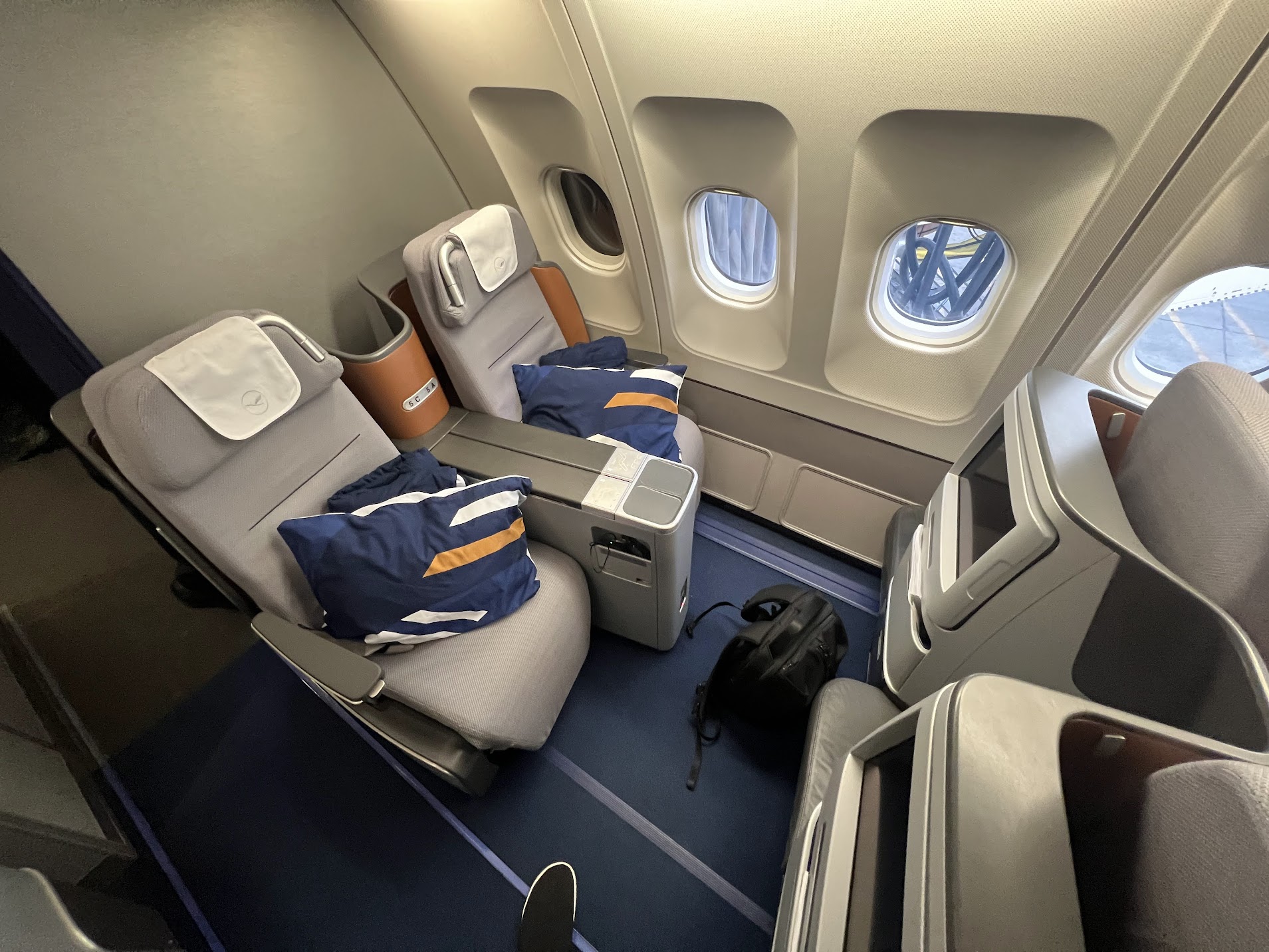
Lufthansa’s seats and cabin were designed over 10 years ago and are slowly being replaced by the new Lufthansa Allegris product that offers more privacy and aisle access to window seats. 5 rows of Business class seats are at the front of the plane in a 2-2-2 configuration, and I scored window seat 5A out of limited options.
The last row is next to the lavatories, which I didn’t find an issue, especially given that this was a nighttime flight. During most of the flight, the lavatories were stocked with mouthwash, eyemasks, shaving kits, hand sanitizers, and earplugs. The sink was clogged during the last few hours of the flight.

Even though the seats are nearly identical to the ones used on the newer Boeing 747, window seats have a personal feet cubby against the cabin wall. Rather than having seats pointed to the middle of the two, these are slightly pointed toward the windows, which I loved, although the space against the wall initially looked narrow.
The seat felt comfortable, with plenty of space to stretch out. It might be related to the age and wear of the seat, but the seat seemed to have little energy left because it didn’t move into the positions I wanted without standing up while making the adjustments via the panel in the armrest. This didn’t happen on the recently reviewed Boeing 747.


The armrest on the right houses a sturdy tray table, the aforementioned seat controls, IFE remote and an area for drinks for when the table is put away. The seatback in front includes an old non-touchscreen IFE system that can be pulled out and moved to the right for a better viewing angle. There was a lot of glare, the panel had low resolution, and I used it mainly for a live map, plus I watched a few episodes of Law & Order. There is a pocket for magazines, a complimentary bottle of water, and the Porsche Design amenity kit underneath the screen.
Despite the plane’s age, the cabin, as well as the seats, were clean. Blankets and pillows were placed on seats, but no mattress toppers were on this flight.
Let’s Put Sleeping to the Test
I found sleeping surprisingly comfortable. The lie-flat seat is narrow but slightly over 6ft 5in in length, which was perfect for me. I can’t say that about all Lufthansa Business class seats, like the ones on 747’s upper deck. A slight difference in the seat’s placement and plane model can make a huge difference!
The crew kindly asked passengers to shut window blinds when dinner service was over as sunset was nearing. It was dark in the cabin during most of the flight, which was perfect for sleeping and entertainment.

I got a good 4-5 hours of sleep and listened to music for a few hours afterward. There was no mattress topper, but the seat was soft enough for sleeping.
Meal Service & Crew
The cabin crew on this flight was nothing short of stellar. 30 business class seats on a plane isn’t the smallest number, but it’s multiple times more compact than on double-deckers, for example. The business class cabin felt intimate, and FAs got to know the passengers better than larger aircraft allow. The senior-level FA serving the aisle close to my seat was extremely polite, professional, and attentive; he leaned down when taking orders and made sure tablecloths were perfectly placed on the tables. At the beginning of the flight, he came to each seat, welcomed passengers personally, and confirmed their language. The worst part of the service was not being able to thank this FA after the flight because he moved further back and was surrounded by crowds.
The FAs collected dinner orders from all passengers and brought out dishes individually, avoiding blocking isles with carts. The praiseworthy FA knew it was a possibility they’d run out of shrimp appetizers, so he asked for my 2nd option far in advance. This, again, reflects service excellence on this flight.
Catering out of Denver could have been better. I opted for the shrimp appetizer, which had run out before they got to my seat, so I was served the beef dish. Eating this meat felt like chewing on a rubber boot texture-wise, and it was stone cold. The salad tasted fresh, but the dressing was unappetizing in plastic packaging. I also had beef as the main course, which was overcooked and oily. I opted for the cheese plate afterward, which didn’t leave a good impression, either. The cheese appeared to have been left outside for a while, the grapes weren’t fresh, and the crackers came in plastic wrapping.
Breakfast time was around an hour before landing. The FA came to me first to get my order (hot or cold option) since I didn’t get my 1st option last night. This was a thoughtful touch! The hot option was a cheese and ham omelet with some bacon on the side, plus fruit. Bread was offered with every course. The bacon seemed old, but the rest was quite good, and breakfast was the best meal on this flight. I also had a promptly delivered espresso and orange juice.


Landing
Landing in Frankfurt went smoothly, and after a long taxi, we arrived at a Z gate equipped with two jet bridges right next to Boeing 747s. Deplaning was quick, but I was surprised that no automated passport control machines were on the way to the Schengen area. Around a 10-minute wait later, I was through.


Conclusion
Let’s face it: Lufthansa has trouble delivering a consistent experience on all its aircraft and routes. The seat was OK for this nearly 10-hour flight, and the incredible crew shined so bright they almost made me forget about the unacceptable food. Plus points for maintaining the plane so well that it didn’t look or feel like one from the early 2000s. I’m certainly open to flying this aircraft again, but perhaps from Frankfurt or a different Lufthansa hub next time with decent catering and a good stock of mattress toppers.
I had initially purchased an economy ticket, which I upgraded to Business for a cash price of $1,560, making the approximate total cost of this one-way flight $2,500. This is quite reasonable compared to the nearly $7,000 prices for the last couple of remaining seats a week before departure.
Leave a Reply